SATELLAI Collar Review: GPS, Fence and Health Data, With Caveats
SATELLAI packs LTE tracking, unlimited virtual fences and AI health alerts into one 6.5 oz collar. The hardware is ambitious, but the price, the plan and the battery claims need a close look.
Our verdict
A feature-rich collar that tries to be a GPS tracker, a virtual fence and a health monitor at once. The specs are strong, but the price has drifted well above the $399.99 it launched near, the plan is mandatory, and owner ratings on retail sites are lukewarm. Wait for proof on the battery before paying full price.
- Best for
- Large dogs and owners who want one device for fence and tracking
Three jobs, one neck. That is the pitch behind the SATELLAI Collar: a live GPS tracker, a virtual fence and a health monitor that notices changes in how your dog moves and breathes. Each of those jobs already has a specialist, and each specialist costs real money. So the question is not whether the collar does a lot. It is whether doing a lot at once is worth the bill.
We worked from the maker's documentation, its live pricing and the independent write-ups we could find. Where a number comes from a source rather than from a bench, we say so.
What the page promises
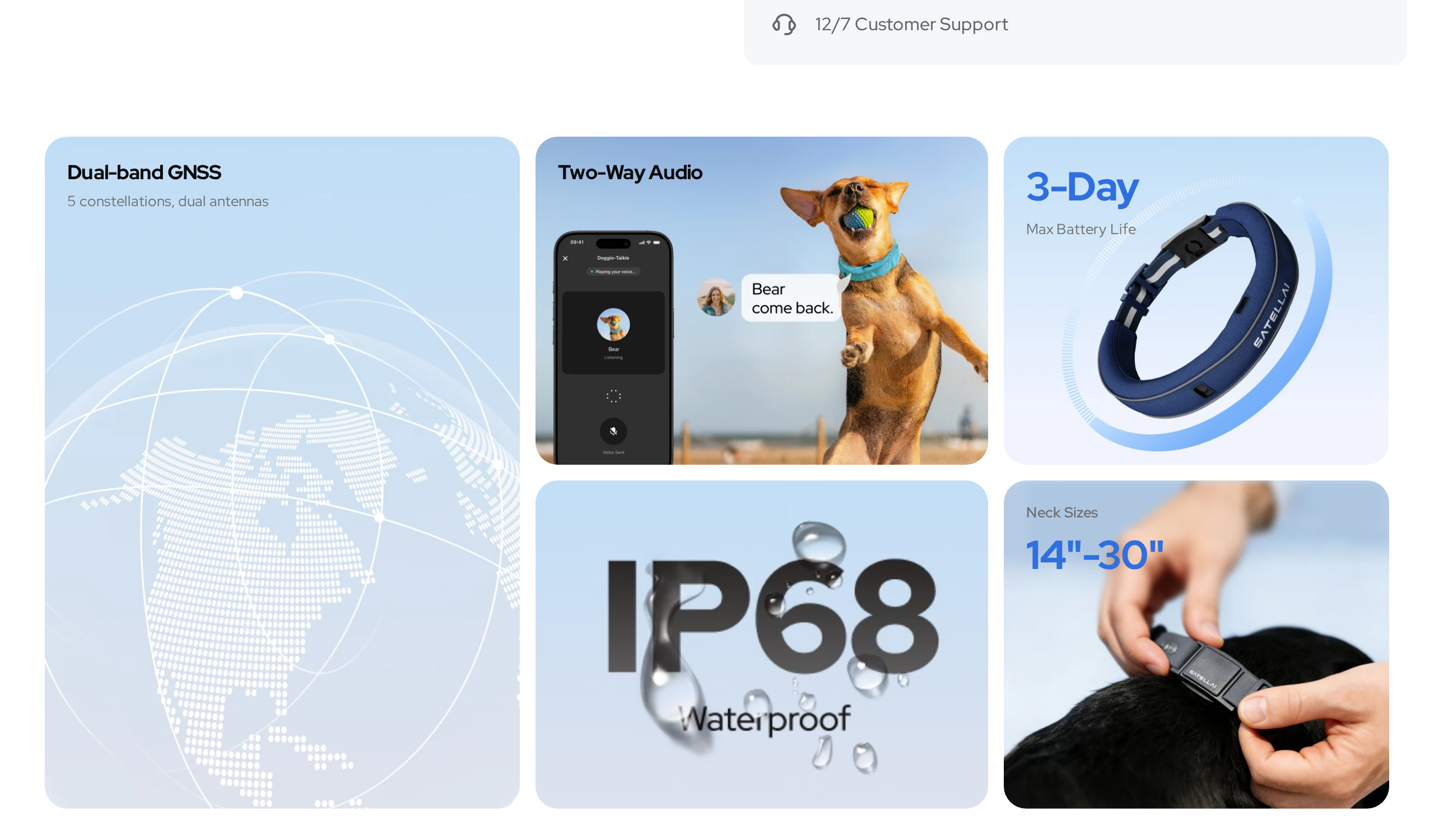
The headline claims are off-leash safety with unlimited virtual fences, live GPS tracking, two-way audio and up to three days of battery. The collar weighs 6.5 oz, fits necks from 14 to 30 inches and carries an IP68 rating, which covers dust and full submersion.
The positioning stack is the strongest part. The maker lists dual-band GNSS across five satellite constellations with dual antennas, plus LTE on more than 680 carrier networks. The fence data lives on the collar itself, so the boundary keeps working while the phone link is down, as long as the collar can see GNSS satellites.
The price moved, and the plan is not optional
Coverage from earlier this year quoted the collar at $399.99. On the maker's own page when we checked, it showed $495.99, struck down from $619.87. That is a sale price, and sale prices change, so treat the $399.99 figure as history and the page as the only number that counts on the day you buy.
The plan is the second half of the cost. Retail listings state that a telecom plan is required to unlock the fence, live tracking, health data and escape alerts. One outside review puts the monthly plan at $9.99, or $119.88 a year. The page itself starts at $7.92 a month on the longer bundles.
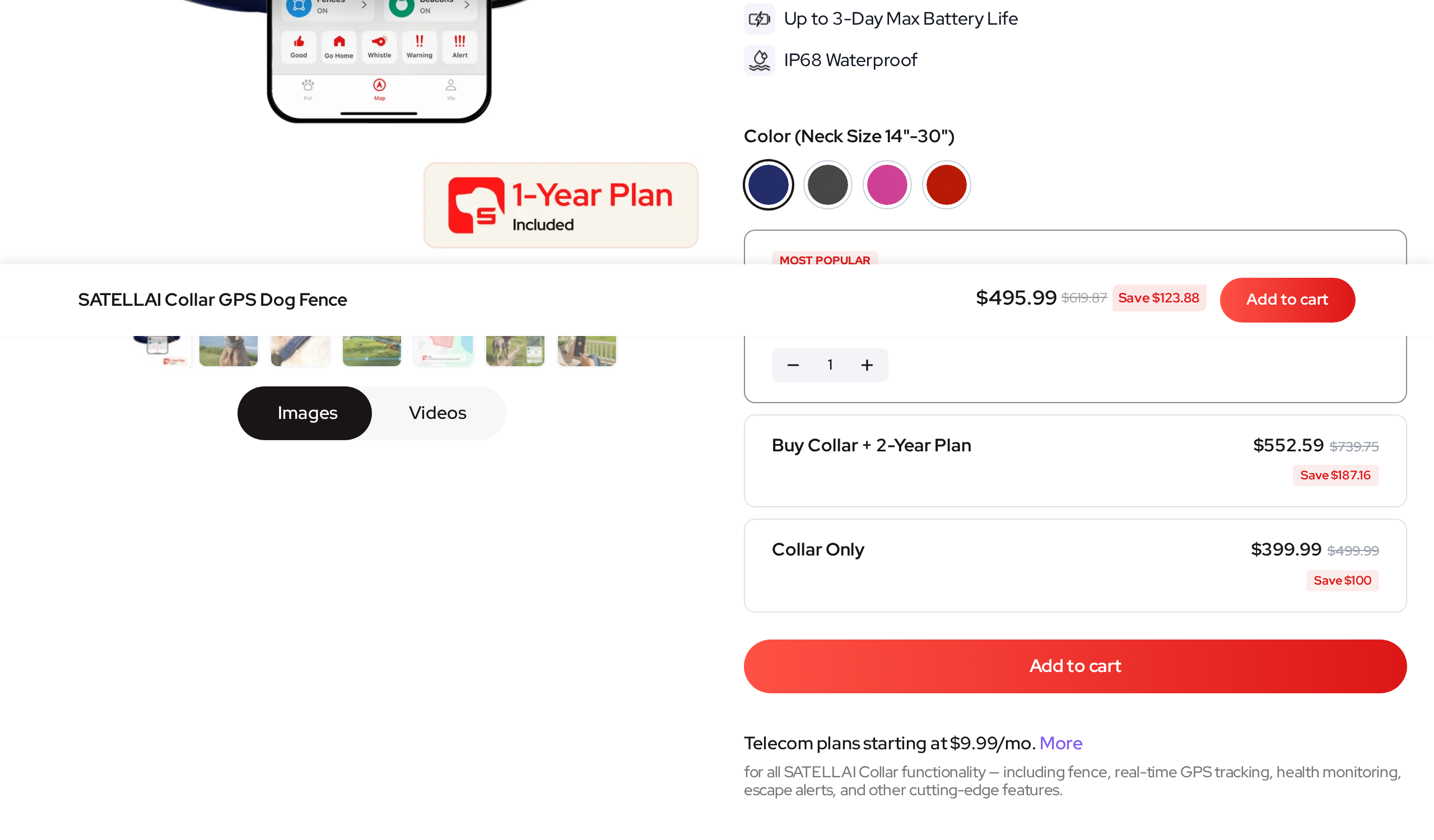
Do the sum for two years. At $9.99 a month the plan alone is about $240, which puts the full outlay near $735 before tax. A basic tracker from the cheaper end of the market costs a fraction of that. You are paying for the fence and the health layer, so only buy this if you will use both.
Where the battery claim gets slippery
The maker's page says up to 3 days at maximum use and 10 days of standby, from a 1600 mAh cell charged in about 2 hours. A review on TechnoBark reports 5 to 7 days. Some retail copy says 5 days, and Chewy and Walmart shoppers have complained that the collar needed charging more often than advertised.
All three can be true. Update rate, fence activity and signal strength change the drain, and a collar that reports every second on LTE will not match one that sleeps. The honest reading is to plan on the maker's 3 days and treat anything better as a bonus. If you hike all day with a dog that wanders far, charge it nightly.
Health tracking: promising, unproven
The AI layer watches running, walking and resting patterns, and the maker lists head shake detection and breathing rate monitoring, with daily and weekly summaries and a chat assistant. The homepage frames it as knowing how your dog feels.

We could find no independent study that checks those readings against a veterinary measurement. Use the data as a prompt to look closer at a dog that seems off, not as a diagnosis. Anything that worries you belongs with a vet.
Who should skip it
Skip it if your dog is small, or a cat: the 14 inch minimum neck rules you out. Skip it if you only want to find a dog that slips the leash, because a plain tracker does that for much less. Skip it if you want hard proof of accuracy before buying, since the independent testing we found was thin, and the star ratings of 3.7 at Walmart and 3.2 at Chewy suggest owners are not all happy.
Who should consider it
A large, athletic dog, a rural home with no fence and an owner who wants fence control, tracking and activity trends in a single app. For that buyer the unlimited fences stored on the device are a real advantage, and 90 days to return it softens the risk.
We rate it 6.4. The hardware list is excellent and the evidence behind it is not yet. At $399.99 this would be an easy recommendation for the right dog. At $495.99 plus a plan, wait for more owner reports.
What we liked, and what we did not
Pros
- Unlimited fences stored on the collar, so a dropped signal does not wipe the boundary
- Dual-band GNSS with five constellations and dual antennas, plus LTE on 680+ networks
- Two-way audio and IP68 waterproofing in a single collar
- Health tracking covers head shaking and breathing rate, not just steps
Cons
- Collar and plan together cost far more than a basic tracker over two years
- Maker lists up to 3 days of battery, while some coverage claims 5 to 7 days
- Neck sizes start at 14 inches, so small dogs and cats are out
- Retail ratings of 3.7 (Walmart) and 3.2 (Chewy) show mixed owner experience
- Proprietary charger means a lost cable is a replacement purchase
Specifications
- Price (maker's page)
- $495.99, list $619.87
- Plan
- From $7.92 to $9.99 a month; 1-year and 2-year bundles
- Weight
- 6.5 oz (collar)
- Neck size
- 14 to 30 inches
- Battery
- 1600 mAh; up to 3 days max, 10 days standby
- Charge time
- About 2 hours
- Positioning
- Dual-band GNSS, 5 constellations, dual antennas
- Network
- LTE, 680+ carrier networks
- Water rating
- IP68
- Warranty and returns
- 1 year; 90-day guarantee