iFetch Too Review: Can a Machine Teach a Big Dog to Play Fetch?
The $229.99 iFetch Too launches standard tennis balls up to 40 feet and asks your dog to reload it. We looked at how fast dogs learn it, how long it lasts, and what to watch for indoors.
Our verdict
The iFetch Too does something no plush toy can: it lets an obsessed ball dog play fetch alone, and the maker says some owners train it in under 20 minutes. It costs $229.99, mixed owner ratings point to jams and units that stop launching, and unsupervised play at full power is not safe. Buy it for a high-energy, ball-crazy dog and stay in the room until the routine is solid.
- Best for
- Ball-obsessed medium and large dogs, with supervision
There are two kinds of fetch dogs: the ones who bring the ball back and then wait, and the ones who never stop. The second kind wears out an arm in ten minutes, and that is who the iFetch Too is for. It is a ball cannon with a chute on top. The dog learns to drop the ball in, and the machine throws it again.
The idea is easy to like. Whether it is worth $229.99, and how safe it is in a living room, is less obvious.
How it works, and why training is the product
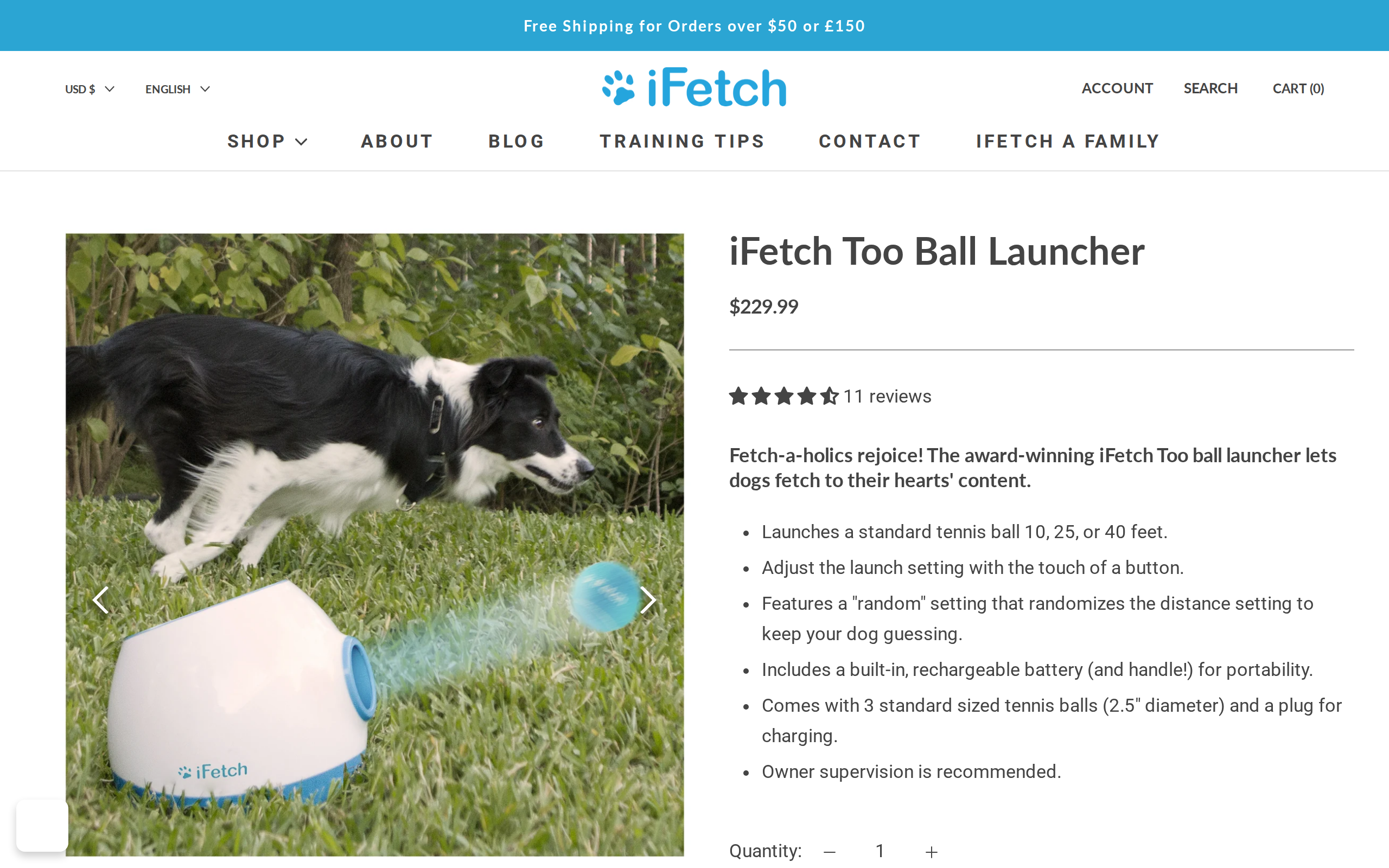
You choose a distance, 10, 25 or 40 feet, or a random setting that varies each throw. The dog fetches the ball, carries it back to the top opening, and drops it in. The maker describes it as three steps, and the first of them is the hard one.
Teaching the drop is where owners succeed or give up. iFetch's own FAQ says some customers trained their dog in under 20 minutes, with a handful of treats, but that figure comes from dogs that already fetch. A dog that never retrieves will not suddenly start because a machine appeared. Plan on a week of short sessions for an average dog, and consider that a guess, not a measurement. The maker also publishes training tips for the stubborn ones.
Safety: the part we would not skip
The FAQ states that supervision is required until the dog is fully trained, especially at higher settings, because the launch speed could cause injury. We would go further. A ball that leaves a machine at speed is not a toy at arm's length; it is a projectile in a house with glass, stairs and children.
Practical rules we would follow:
Start on the 10 foot setting, in a hallway or room with a clear line and a rug, never a hardwood stairwell.
Keep the dog's mouth and your fingers away from the chute while it is armed.
Use full-size balls only. The maker sells a slobber-proof Foaber option, and the original iFetch uses a 1.5 inch ball that the company warns is a choking risk for bigger dogs, which is a reason to avoid mixing models.
Turn it off when you leave.

Dogs with hip problems, puppies with soft joints and animals that already guard objects fiercely are poor candidates. Ask your vet about a high-impact chase habit before you automate it.
Power, noise and reliability
The Too runs on a built-in rechargeable battery with a handle, and the FAQ lists a charge time of 2 to 8 hours. Reviewers put it at roughly 250 to 300 launches per charge. The company does not state noise for this model; it does say the non-electronic Frenzy makes none, which tells you the Too is not silent.
Reliability is the weak spot. Retail ratings sit near the middle, and complaints repeat: balls that jam, units that stop launching after a while, and batteries that fade. Those are owner reports, not our own failure rate, but they are consistent enough to take seriously. The 30 day return window costs a $15 restocking fee, so decide quickly if it fails to suit you, and keep the 90 day warranty on replacements in mind.
Before you commit the money
Borrow the idea first. Spend a week hand-feeding a tennis ball into a bucket and rewarding the drop. If your dog drops balls on command and loves repeating it, the machine will land. If the dog chews the ball, stands over it or walks off, you have saved $229.99 and found out cheaply.
What else is on the shelf

The collection shows the alternatives inside the same brand. The original iFetch uses smaller balls and six C-cell batteries. The Frenzy is a ball-drop puzzle for small and medium dogs, with no electronics and no noise at all. If your dog is small, or you only want mental exercise, the cheaper toy is the better answer.
The verdict
Buy the iFetch Too if your dog already adores tennis balls, weighs enough for the ball size, and you will watch the first weeks. It buys you real, repeatable exercise on a rainy day, which is worth something.
Skip it if you plan to leave a dog alone with it, if the dog is small, or if you hate gambling on a $229.99 gadget with patchy reliability. We rate it 6.8: a clever idea that works best for exactly one kind of dog.
What we liked, and what we did not
Pros
- Launches full-size tennis balls at 10, 25 or 40 feet, or a random mix of distances
- Dog drops the ball into the chute, so no human thrower is needed
- Rechargeable internal battery and a built-in carry handle
- Maker reports under 20 minutes of training for dogs that already fetch
Cons
- Costs $229.99, with a $15 restocking fee on 30 day returns
- Owner ratings are mixed, with reports of jams and units that stop launching
- Supervision is required while a dog is learning, because launch speed can injure
- Small dogs are out: the ball size and power target medium to large breeds
Specifications
- Price
- $229.99
- Launch distances
- 10, 25 or 40 ft, plus a random setting
- Ball size
- Standard tennis ball, about 2.4 to 2.7 in
- Balls included
- 3
- Power
- Built-in rechargeable battery
- Charge time
- 2 to 8 hours (maker FAQ)
- Runs per charge
- Roughly 250 to 300 launches (reviewer figure)
- Dog size
- Medium to large
- Returns
- 30 days with a $15 restocking fee
- Repairs
- 90 day warranty on replaced or repaired units